Six AMR Types — Full Warehouse Coverage
From compact latent robots for e-commerce picking to heavy conveyor-integrated systems and carton transfer units — we source the right AMR type for your application and throughput requirements.

Latent Mobile Robot (LMR)
Goods-to-person pod-lifting robot — 500 kg capacity, 3× pick rate, no fixed racking required.
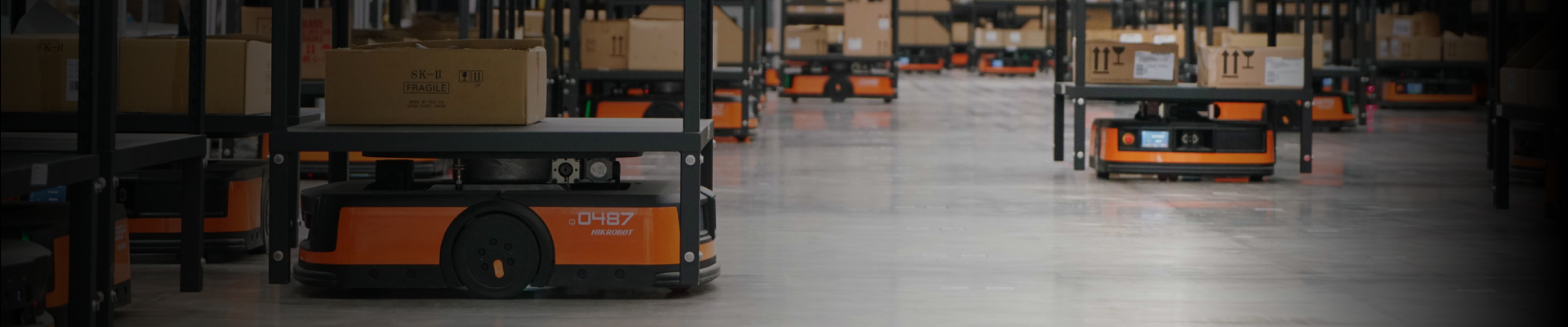
Chassis AMR
Autonomous cart transport — person-following, WMS-dispatch, and call-button modes, works with existing carts.

Forklift AMR (FMR)
Autonomous forklift — 1,500 kg, 6 m racking reach, laser fork guidance, 24/7, cold store rated to -25°C.
Pallet Jack AMR
Ground-level autonomous pallet jack — dock-to-staging, conveyor infeed, 2,000 kg, 12 h battery.
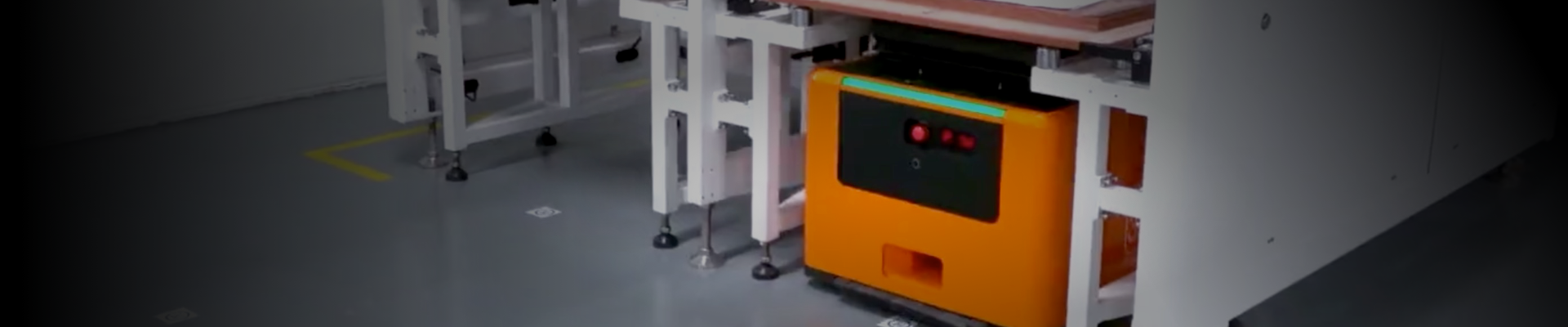
Conveyor AMR (CMR)
Onboard belt conveyor AMR — bridges fixed conveyor lines with any-to-any routing, ±5 mm dock accuracy.
Carton Transfer Unit (CTU)
High-throughput carton sortation AMR — 1,000+ units/h, unlimited destinations, no single point of failure.
LMR — Latent Mobile Robot (Goods-to-Person)
Most PopularShelf-pod lifting · Dual-axis navigation · Stationary pick station
The Latent Mobile Robot (LMR) is the core goods-to-person picking solution, pioneered by Amazon Robotics (Kiva) and now produced at scale by HIKROBOT, Geekplus, Quicktron, and other Chinese OEMs. The robot navigates under a shelving pod using 2D LiDAR SLAM, then inserts a lifting mechanism to raise the pod and carry the entire shelf structure to a human pick station — eliminating all picker walking.
At the pick station, the picker scans and picks from the pod face. The WMS directs the picker to the correct slot on the pod and confirms the pick via light indicator or screen. The LMR then transports the pod back to its storage position or directly to the next station — optimising pod routing based on order demand patterns and pod SKU affinity.
Key safety features include multi-level obstacle detection (2D LiDAR + 3D depth sensor + bumper), automatic deceleration in human zones, and emergency stop on contact. All LMRs communicate with the fleet management system (FMS) via 5GHz Wi-Fi for real-time task assignment, traffic management, and automatic charging dispatch when battery drops below a set threshold.
Performance Benchmark
Manual aisle picking: 50–80 picks/hr. LMR goods-to-person: 300–600 picks/hr per station. A 3-station system with 40 LMRs handles the output equivalent of 15–20 manual pickers — with higher accuracy and no fatigue-related errors.
| Robot class | LMR (Latent Mobile Robot) |
| Pod payload | 500–1,200 kg (pod + goods) |
| Max robot speed | 1.5 m/s (loaded), 2.0 m/s (unladen) |
| Navigation | 2D LiDAR SLAM + IMU + odometry |
| Positioning accuracy | ±10 mm |
| Obstacle detection | LiDAR + 3D depth sensor + bumper |
| Safety standard | ISO 3691-4, CE, PL-d |
| Battery | Li-ion, 8–12 hr runtime |
| Charging | Auto docking, opportunity charge |
| Comm protocol | 5GHz Wi-Fi, fleet FMS |
| Pick rate (per station) | 300–600 picks/hr |
| Certifications | CE / FCC / RoHS / ISO 9001 |
Chassis AMR — Autonomous Cart Robot
Rapid Deploy No Infra ChangePerson-to-goods · Cart-following · Existing layout compatible
The chassis AMR (also called autonomous cart or co-bot) operates in person-to-goods mode: it follows a human picker through existing warehouse aisles, autonomously carrying their picking tote or cart. The picker focuses entirely on scanning and picking; the robot handles all tote transportation — removing the heaviest and most fatiguing part of traditional aisle picking.
Because no racking reconfiguration is required, deployment takes 1–2 weeks including map commissioning and Wi-Fi tuning. This makes the chassis AMR the fastest-ROI automation option for existing 3PLs, food & beverage DCs, and industrial parts stores that cannot disrupt live operations for a full ASRS installation. Picker walking reduction is typically 40–60%, with 15–30% throughput improvement per picker.
Person-Following Technology
The robot uses a combination of 2D SLAM for general navigation and a person-following algorithm (visual tracking + proximity sensing) to maintain safe distance behind the assigned picker. It automatically pauses at cross-aisles and waits at pick stations without blocking traffic.
| Payload | 50–300 kg (cart / tote rack) |
| Navigation | 2D SLAM + person-following |
| Max speed | 1.2 m/s |
| Positioning accuracy | ±20 mm (navigation) |
| Aisle width required | Min. 1,200 mm (standard) |
| Obstacle avoidance | 360° LiDAR + ultrasonic |
| Battery | Li-ion, 8 hr per charge |
| Charging | Manual dock or auto-return |
| Deployment time | 1–2 weeks (no infra change) |
| ROI timeline | 6–18 months typical |
| Picker walk reduction | 40–60% |
| Certifications | CE, ISO 3691-4 |
FMR — Forklift Mobile Robot (Autonomous Pallet Handler)
24/7 Operation 1,500 kgCounterbalance + reach-forklift variants · 3D pallet detection · Safety PL-d
The Forklift Mobile Robot (FMR) is a purpose-built autonomous unit for full-pallet handling in receiving docks, staging areas, put-away operations, and inter-zone pallet transport. Unlike a standard forklift retrofitted with an automation kit, the FMR is engineered from the ground up for autonomous operation — with LiDAR SLAM navigation, high-precision 3D pallet fork-pocket detection cameras, and safety-rated laser scanners certified to ISO 3691-4 / PL-d.
Two primary variants are available: the counterbalance FMR (for open-floor pallet transfer up to 3–5m lift height) and the reach FMR (for racking put-away up to 6m in narrow aisles, min. 2,700mm aisle width). The 3D depth camera on the fork carriage performs pallet face identification, pocket localization, and tilt compensation before insertion — achieving fork-pocket entry success rates above 98% on standard pallets.
FMRs communicate via 5GHz Wi-Fi with the Fleet Management System (FMS) and WMS, receiving task assignments, reporting completion, and requesting charging automatically. Integration with dock door sensors and conveyor I/O points allows end-to-end automated receiving flows without human intervention.
Safety Architecture
Dual safety-rated LiDAR scanners (front + rear) create configurable protection zones: warning zone (decelerate), protective zone (halt), mute zone (narrow aisle). All safety functions comply with ISO 13849-1 PL-d, Category 3 — the standard required for human co-working environments in most EU/CIS jurisdictions.
| Robot class | FMR (Forklift Mobile Robot) |
| Payload capacity | 500–1,500 kg |
| Lift height (reach) | Up to 6.0m (rack put-away) |
| Lift height (CB) | Up to 3.0m (floor transfer) |
| Navigation | LiDAR SLAM + 3D vision pallet ID |
| Fork-pocket accuracy | ±10 mm (3D camera guided) |
| Max speed (loaded) | 1.2 m/s |
| Max speed (unladen) | 1.8 m/s |
| Aisle width (reach) | Min. 2,700 mm |
| Safety scanners | Dual safety LiDAR, ISO 13849-1 PL-d |
| Battery | Li-ion, 8 hr, auto-charging |
| Certifications | CE, ISO 3691-4, PL-d, FCC |
Pallet Jack AMR — Ground-Level Transfer
Dock Operations 2,000 kgFloor-level · Low-profile chassis · Dock-to-staging · Fast ROI
The autonomous pallet jack robot handles ground-level pallet movement — from dock doors to staging areas, between production line feed points, and within single-level DCs. At 200–250mm overall height (forks lowered), it slides under any standard pallet and travels at up to 1.5 m/s without a driver. This replaces the most common and accident-prone use of manual pallet jacks and ride-on tuggers in receiving and dispatch operations.
The pallet jack AMR is significantly lower cost and faster to deploy than a full forklift AMR while covering the majority of ground-floor pallet transfer tasks. Opportunity charging capability means robots can top up during natural breaks in traffic without returning to a fixed charging bay — maximising uptime in high-throughput dock environments.
Dock Integration
Pallet jack AMRs can be integrated with dock door sensors, ERP-driven inbound manifests, and barcode scan-on-entry systems — creating a fully automated dock-to-staging flow without any manual pallet handling. Alert triggers notify warehouse staff when a robot is waiting for dock door access.
| Payload capacity | 1,000–2,000 kg |
| Lift height | 200mm (ground clearance only) |
| Robot height (forks down) | 200–250mm (under standard pallet) |
| Navigation | 2D LiDAR SLAM |
| Max speed | 1.5 m/s (loaded) |
| Obstacle avoidance | 360° LiDAR + ultrasonic bumper |
| Battery | Li-ion, 10 hr runtime |
| Charging | Opportunity charging capable |
| Floor flatness requirement | FM2 (DIN 15185) recommended |
| Pallet type | EUR, ISO, block pallet |
| Safety | Safety LiDAR, PL-d |
| Certifications | CE, ISO 3691-4 |
CMR — Conveyor Mobile Robot
Tote Handling SortationOnboard belt/roller conveyor · Tote-to-person transport · Sort induction
The Conveyor Mobile Robot (CMR) combines autonomous navigation with an onboard conveyor or roller surface — enabling it to receive, transport, and transfer totes, cartons, and parcels between workstations, pick zones, pack benches, and sortation points without fixed conveyor infrastructure. CMRs are the flexible alternative to rigid belt conveyor systems in order fulfillment and returns processing operations.
At transfer points, the robot's onboard conveyor activates to slide the tote onto a fixed station conveyor roller, a workbench, or another CMR. This creates a fully automated tote transport network between the ASRS output, pick stations, pack benches, and shipping sorters — without any of the inflexibility of fixed conveyors that lock in layouts for 10–15 years.
CMR vs Fixed Conveyor
Fixed conveyor: layout is fixed at install, any change requires construction work. CMR network: workstations can be repositioned in hours by updating the map and task logic. Ideal for 3PLs with seasonal layout changes or growing e-commerce operations adding new pack benches.
| Robot class | CMR (Conveyor Mobile Robot) |
| Onboard surface | Belt conveyor or roller array |
| Payload (totes) | 30–80 kg per robot |
| Tote format | 600×400mm, 400×300mm |
| Navigation | 2D LiDAR SLAM |
| Max robot speed | 1.5 m/s |
| Transfer accuracy | ±5 mm (tote transfer point) |
| Transfer method | Belt/roller to station dock |
| Battery | Li-ion, 8–10 hr runtime |
| Charging | Auto dock + opportunity charging |
| Comm protocol | 5GHz Wi-Fi, FMS integration |
| Certifications | CE, ISO 3691-4 |
CTU — Carton Transfer Unit
High Throughput Multi-TierVertical lift + horizontal transport · Multi-floor carton flow · ASRS outfeed
The Carton Transfer Unit (CTU) is a high-throughput autonomous vehicle designed specifically for carton and case-level handling in multi-story or multi-tier warehouse environments. The CTU travels on dedicated rail or floor tracks between vertical lifts and horizontal transfer zones, handling individual cartons or totes at rates of up to 800–1,200 units/hr per lane — far exceeding what a general-purpose AMR can achieve at this unit weight.
CTUs are most commonly deployed as the outfeed transport mechanism in tote-shuttle or 4-way shuttle AS/RS systems — connecting the ASRS I/O conveyor output to pick stations, pack benches, or cross-belt sorters across different floors or zones. They replace long stretches of fixed belt conveyor between buildings or zones, preserving layout flexibility while matching fixed-conveyor throughput performance.
Integration with ASRS
CTU networks pair directly with 4-way tote shuttle systems: the ASRS delivers totes to an I/O station; CTUs collect and distribute totes to the correct pick station or pack bench, then return empties to the ASRS infeed — creating a closed-loop automated material flow requiring zero manual handling between storage and packing.
| Robot class | CTU (Carton Transfer Unit) |
| Unit throughput | 800–1,200 totes/hr per lane |
| Payload per cycle | 1–3 totes (50 kg total) |
| Travel mode | Rail-guided or floor-guided |
| Vertical lift | Shared lift shaft (multi-floor) |
| Horizontal speed | 2.0–3.0 m/s |
| Vertical lift speed | 1.5 m/s |
| Tote format | 600×400mm standard |
| Power supply | Rail-mounted conductor bar |
| Control system | WCS task dispatch, zone control |
| Integration | Direct ASRS I/O dock or conveyor |
| Certifications | CE, machine safety directive |
AMR Navigation & Safety Systems
Understanding the core technology behind modern warehouse AMRs — from LiDAR SLAM navigation to functional safety certification.
LiDAR SLAM Navigation
No floor marks · No infrastructure change
All modern AMRs use SLAM (Simultaneous Localization and Mapping) with a 2D LiDAR sensor as the primary positioning input. During commissioning, the robot scans and builds a 2D map of the warehouse using racking faces and walls as landmarks. In operation, the robot continuously matches its real-time LiDAR scan against the stored map, achieving localization accuracy of ±10–30mm without any floor tape, QR codes, or magnetic strip installation.
Functional Safety — ISO 3691-4 / PL-d
Human co-working certified
Warehouse AMRs deployed in human co-working environments must meet ISO 3691-4 (industrial trucks safety) and typically achieve ISO 13849-1 PL-d Category 3 on their safety functions. The safety system uses dedicated safety-rated LiDAR scanners (separate from navigation LiDAR) with configurable protection zones: a warning field (decelerate to 0.3 m/s) and a protective field (emergency stop). Contact bumpers provide a final mechanical layer.
Fleet Management System (FMS)
Real-time traffic · Task dispatch · WMS bridge
The Fleet Management System (FMS) is the central software layer that assigns tasks, manages traffic, coordinates charging, and reports status for all robots in the fleet. Communication is via 5GHz Wi-Fi with task cycle times under 500ms. The FMS integrates with the WMS or WCS via REST API, TCP/IP socket, or OPC-UA — receiving pick tasks, storage missions, and pallet transfer orders, then dispatching to the optimal available robot in real time.
Battery & Charging Strategy
Opportunity charge · Auto-dock · Li-ion
All AMR types use lithium-ion battery packs with 8–12 hr runtime. Charging strategy options include: scheduled charging (robots return to dock at shift end), opportunity charging (robot tops up during idle periods without returning to base), and battery swap (hot-swap battery for 24/7 operations). The FMS monitors state-of-charge for every robot and automatically dispatches for charging before battery reaches a critical level — maintaining continuous fleet availability.
3D Vision for Pallet Handling
FMR pallet pocket detection
Forklift AMRs (FMR) use structured-light or ToF (Time-of-Flight) 3D cameras mounted on the fork carriage to detect pallet face, identify fork pocket openings, and calculate fork insertion angle with ±10mm accuracy. The system handles standard EUR and block pallets, accounts for pallet tilt up to ±5°, and verifies correct pallet engagement before lift. Reject rate on standard pallets under controlled conditions: under 2%.
WMS / ERP Integration
REST API · OPC-UA · SAP EWM · Custom WMS
AMR systems integrate with host WMS or ERP via the FMS layer. Standard integration protocols include REST API (JSON), TCP/IP socket (XML or proprietary), and OPC-UA for manufacturing environments. Common integration targets: SAP EWM, Oracle WMS, Infor WMS, and custom-built warehouse management systems. The FMS typically exposes a task API (create task, cancel task, query status) and event callbacks for task completion, robot fault, and battery low alerts.
AMR Market: Chinese OEMs vs Global Brands
The AMR market is dominated by Chinese OEMs that offer comparable technology to Western brands at 40–60% lower cost. Econocontrol distributes from these manufacturers globally.
| Brand | Origin | AMR Types | Market Position | Price Level |
|---|---|---|---|---|
| HIKROBOT | China (Hikvision) | Latent, chassis, forklift | Global top-3, large enterprise | Mid |
| Geekplus | China | Latent, sorting, forklift | Global #1 in shipments | Mid |
| Quicktron | China (Alibaba) | Latent, goods-to-person | E-commerce specialist | Lower |
| Damon Group | China | Full range incl. outdoor | Growing regional | Competitive |
| Econocontrol (Distributor) | Global | All types via certified OEMs | Blue-ocean markets, 24h response | Factory-Direct |
| Locus Robotics | USA | Chassis / cart AMR | 3PL North America focus | Premium |
| 6 River Systems | USA (Shopify) | Chuck (cart AMR) | SaaS-model cart AMR | Premium |
AMR Picking: Key Performance Metrics
E-Commerce Fulfillment
Latent AMR systems handle peak season volume spikes without hiring seasonal workers. Fleet scales from 10 to 200+ robots as order volume grows.
3PL & Contract Logistics
Chassis AMRs deploy in 1–2 weeks in existing 3PL facilities without changing racking. Win multi-client bids with documented throughput improvements.
Manufacturing Line Supply
Forklift and pallet jack AMRs automate parts delivery from stores to production lines, reducing material handler headcount and eliminating manual forklift incidents.
AMR Warehouse Robots: Frequently Asked Questions
Related Solutions & Components
Ready to Automate Your Warehouse Picking?
Share your warehouse dimensions, daily order volume, and SKU count. We'll recommend the right AMR type and fleet size with a 24-hour budgetary quote.