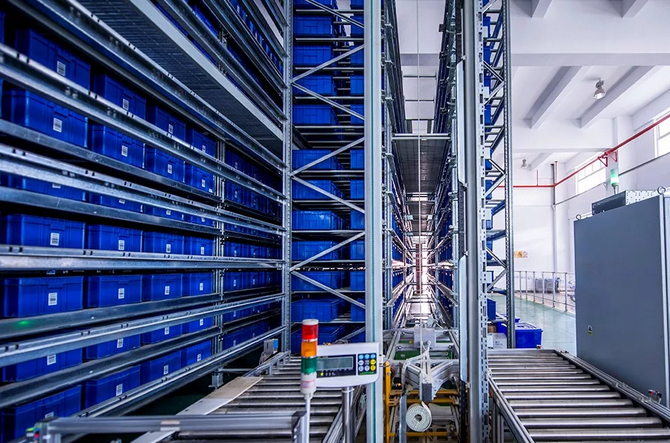
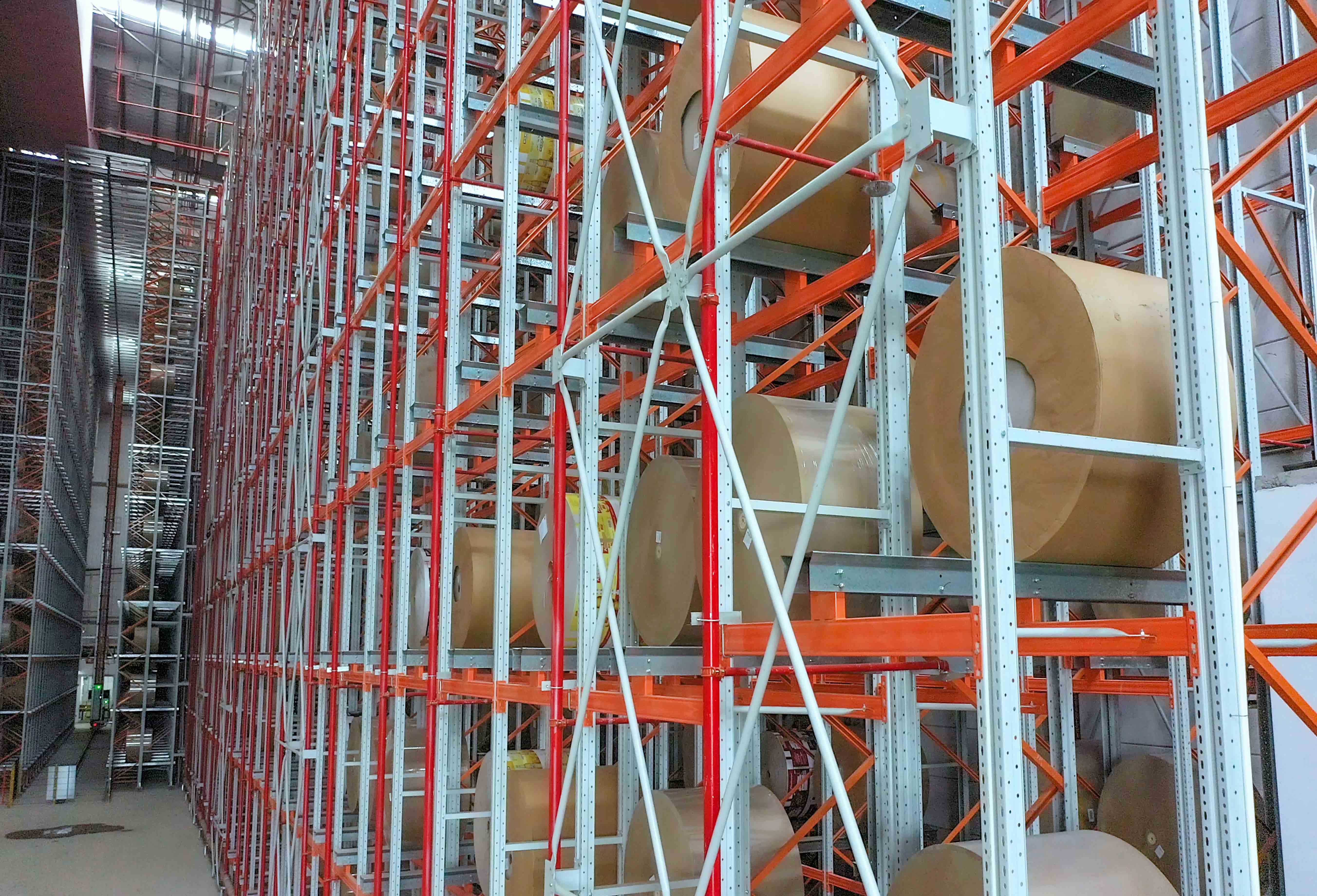
Single-axis shuttle carrier for deep-lane tote buffer storage. Lower cost than 4-way, ideal for high-volume FMCG buffer stores and applications where lane-by-SKU organisation is sufficient.
The 2-way (single-axis) tote shuttle operates along one lane row at a time. The carrier travels in and out along the rail of its assigned lane — simple, reliable, and 20–35% lower in system cost than a 4-way configuration. Each carrier is assigned to a specific lane group by the WCS and serves those lanes sequentially.
Best suited for warehouses with a relatively small number of active SKUs stored in large quantities per lane. Typical use cases: FMCG buffer stores sorting finished goods before dispatch, beverage DC pre-sort zones, bakery finished-goods buffers, and any application where throughput is under 300 cycles/hr per zone and lane-based organisation is sufficient.
A 2-way system can be upgraded to 4-way at a later stage by adding cross-aisle rail infrastructure and updating the WCS routing logic — making it an attractive entry-level investment for growing operations.
A tote is delivered to the infeed roller at the entrance of the target lane. WCS assigns the carrier to that lane and dispatches it to the infeed point.
The carrier extends its lifting forks, picks up the tote from the lane entrance roller, and begins travelling inward along the X-axis rail at up to 3 m/s.
Encoder positioning locates the first empty slot (LIFO) or the deepest available position. Carrier lowers forks to deposit the tote and reverses back to the lane entrance.
On WCS retrieval command, carrier travels to the target tote, lifts and brings it to the lane entrance outfeed roller — ready for onward conveyor transport to the pick station.
No cross-aisle rail, fewer carriers required per zone, simpler WCS routing logic. Delivers 20–35% cost saving versus a comparable 4-way system for low-to-medium throughput applications.
Lane depth up to 60m — suitable for very long storage bays where 4-way cross-aisle travel would add unnecessary complexity. One carrier can serve an entire deep lane without repositioning.
LIFO for production buffer stores where date rotation isn't required. FIFO configured by reversing carrier retrieval sequence — suitable for food and pharma products with expiry dates.
System infrastructure is designed for future cross-aisle rail addition. When throughput outgrows 2-way capacity, upgrade to 4-way by adding Y-axis rails and updating WCS routing — no racking replacement.
Cold-rated carriers with heated battery compartments operate reliably at -25°C for chilled and frozen food buffer storage — a common application in FMCG and food retail DC pre-sort zones.
WCS manages carrier assignment, lane sequencing, and FIFO/LIFO logic. Integrates with host WMS via TCP/IP or REST API for task-driven operation fully embedded in your warehouse workflow.
| Load type | Tote / bin 600×400mm standard; other sizes on request |
| Max load per tote | 30–50 kg |
| Travel axis | X-axis only (single-axis / 2-way) |
| Carrier speed | 2.0–3.0 m/s |
| Positioning accuracy | ±3 มม |
| Lane depth | Up to 60m per lane |
| Storage mode | FIFO or LIFO (WCS configurable) |
| Carriers per lane group | 1 carrier per 2–4 lanes (shared) |
| Max racking height | Up to 25m |
| Battery | Li-ion; heated compartment available for cold chain |
| Battery runtime | 8–10 hr per charge |
| Temperature range | -25°C to +40°C |
| WMS integration | TCP/IP socket, REST API |
| Upgrade path | Compatible with 4-way cross-aisle rail addition |
Share your tote count, lane depth, throughput, and temperature — we respond within 24 hours.