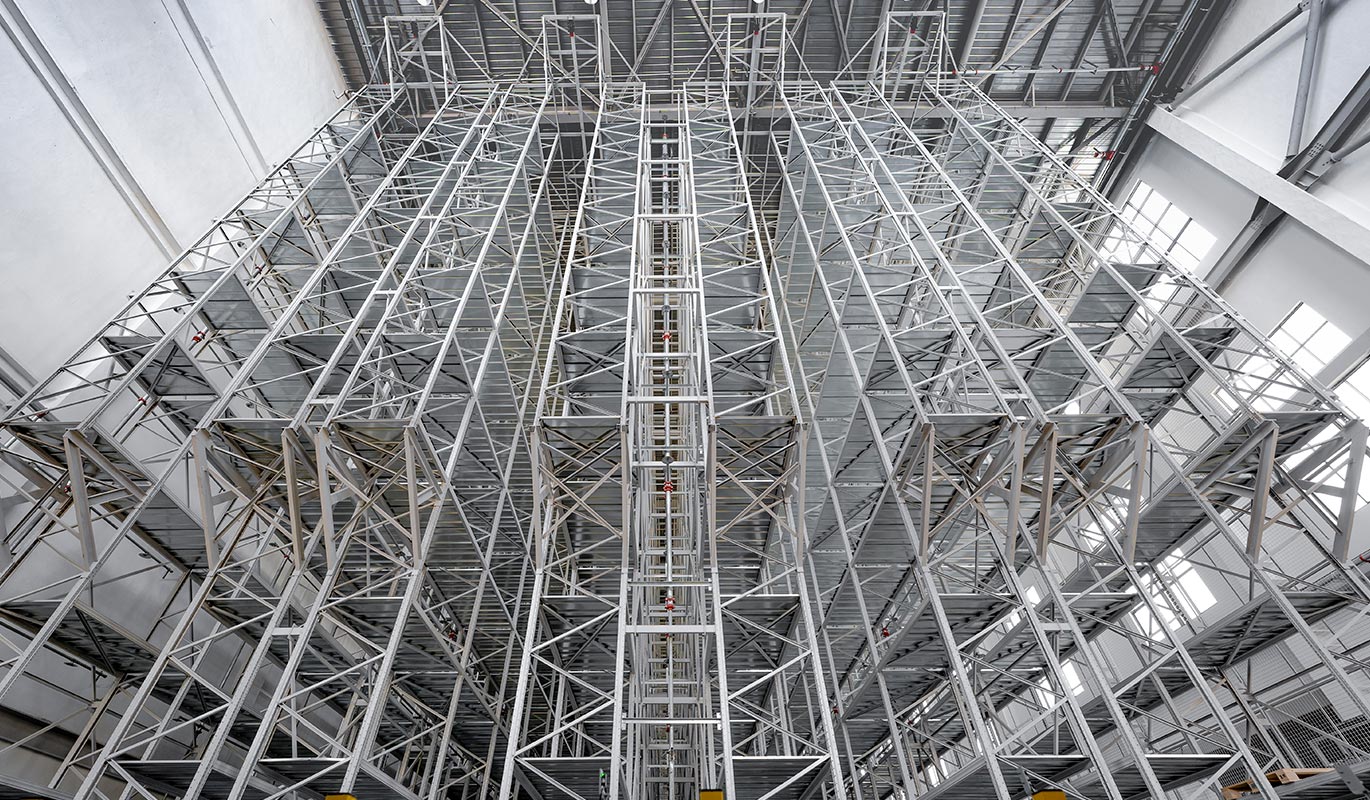
Stack Crane AS/RS
High-Bay Automated Storage

Single-mast stacker cranes for very tall warehouses up to 45m. The industry standard for large-capacity national DCs, cold chain high-bay stores, and manufacturing parts buffers requiring 5,000–200,000 pallet positions.

45m
Max building height
3,000kg
Max load capacity
180m/min
Horizontal speed
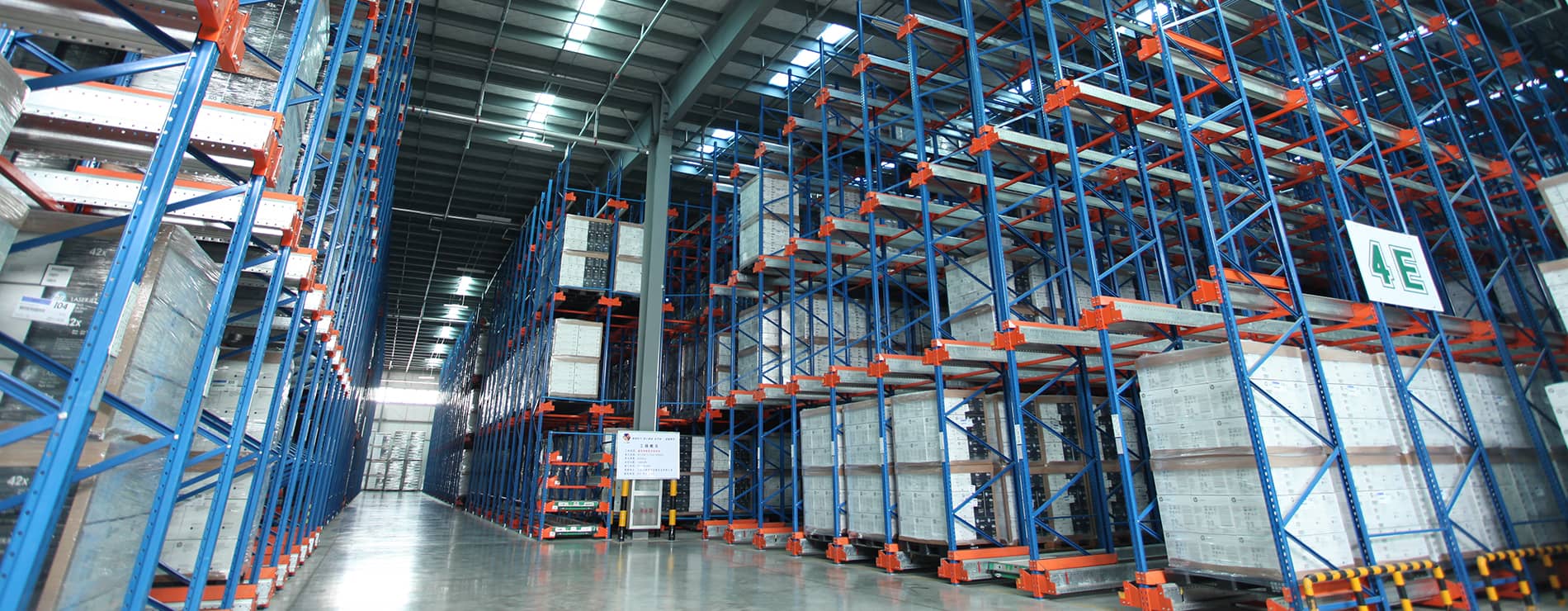
Stack crane AS/RS high-bay automated warehouse stacker crane system

The High-Bay Workhorse — Up to 45m

The stacker crane (stack crane) is the established standard for very tall, high-capacity automated warehouses. Each crane unit runs on a floor-mounted rail track in a dedicated narrow aisle (900–1,200mm wide). A rigid single or double mast supports the Load Handling Device (LHD) — a telescoping fork that extends to deposit or retrieve pallets or totes at any level up to 45m height.

Horizontal travel uses a high-speed servo drive at up to 180 m/min. Vertical hoist uses a variable-frequency drive (typically Control Techniques M700 or ABB ACS880) for smooth acceleration and regenerative braking — recovering up to 30% of hoist energy during lowering cycles. Absolute position encoders on both axes achieve ±5mm positioning accuracy even at maximum height.

Modern cranes support dual-cycle operation: storing one load on the outbound trip and retrieving another on the return — maximising crane utilisation and effective throughput per aisle.

High-bay warehouse automated stacker crane aisle
±5mm
Position accuracy at 45m
30%
Energy recovery (regen)
200K
Max pallet positions

How Stack Crane AS/RS Works

1

Pallet Arrives at I/O Station

Load arrives at the I/O conveyor at the aisle end. WCS reads the barcode/RFID tag, assigns a storage address, and commands the crane to the I/O pick-up position.

2

Crane Travels to Address

Crane accelerates to full speed on both H and V axes simultaneously. Combined diagonal travel minimises cycle time. Absolute encoders provide real-time position feedback.

3

Fork Extends — Load Deposited

LHD telescopic fork extends into the storage channel, lowers to deposit the pallet on rack rails, retracts. SICK sensor confirms successful deposit before crane moves away.

4

Dual-Cycle Return

Crane immediately travels to a retrieval address if a concurrent outbound task exists, collecting a pallet on the way back to the I/O station — dual-cycle maximises crane utilisation.

Why Stack Crane for Your High-Bay DC

🏗️

Maximum Land Efficiency

High-bay warehouses up to 45m store 8–10× more pallets per m² of land vs conventional 10m racking. Critical for high land-cost logistics parks and cold chain real estate.

Regenerative Energy Recovery

Hoist drive uses regenerative braking to recover up to 30% of motor energy during descent — fed back to the DC bus or grid. Significant energy savings in 24/7 operations.

🎯

±5mm Accuracy at 45m

Absolute position encoders on both axes maintain sub-5mm positioning accuracy regardless of height — no accumulated error from incremental counting or thermal expansion correction needed.

❄️

Full Cold Chain Rating

-25°C rated cranes use cold-ambient VFDs (CT M700 with cold-start option), anti-condensation heaters in drive panels, cold-rated steel mast profiles, and SICK sensors with heated housings.

🔄

Dual-Cycle Optimisation

WCS schedules store + retrieve pairs to maximise dual-cycle operation — the crane deposits a load and collects another in the same aisle traverse, effectively doubling throughput vs single-cycle.

🔌

EMS Shuttle Integration

Electrified Monorail System (EMS) overhead shuttle can connect multiple crane aisles and warehouse zones — carrying loads between the ASRS I/O station, production lines, and dispatch staging.

Full Technical Specifications

Stack Crane — Mechanical
Max warehouse heightUp to 45m
Aisle width900–1,200mm (narrow aisle)
Max load capacity500–3,000 kg per crane
Load typePallet, tote, or combined (twin-mast)
Horizontal travel speedUp to 180 m/min (3.0 m/s)
Hoist speedUp to 60 m/min (1.0 m/s)
Combined H+V travelSimultaneous diagonal
Positioning accuracy±5mm (absolute encoders)
Fork typeTelescoping single/double-deep
Temperature range-25°C to +45°C
Stack Crane — Electrical & System
Travel driveVFD — Control Techniques / ABB
Hoist driveCT M700 / ABB ACS880 with regen
Energy recoveryUp to 30% (regenerative hoist)
Power supplyConductor rail or festoon cable
CommunicationWireless LAN / PROFIBUS to WCS
Throughput per crane60–120 pallets/hr (dual-cycle)
Typical system capacity5,000–200,000 pallet positions
WMS integrationTCP/IP, OPC-UA, REST API
Safety systemsSICK LMS safety scanners, overspeed, end-of-aisle buffers
Drive panel heatingAnti-condensation heaters for cold-chain
EMS (Electrified Monorail System) — Optional Add-On
Carrier speedUp to 2.5 m/s
Max payload per carrier100–500 kg
Power supplyOverhead electrified conductor rail (no battery)
RoutingAutomatic switching, loop and branch topology
Use caseCross-zone transport: ASRS I/O ↔ production lines ↔ dispatch staging

Stack Crane Questions

When should I choose a stack crane over a shuttle system?+
Choose a stack crane when: (1) your warehouse is over 20m height — cranes scale economically to 45m whereas shuttle lifts become complex above 20m; (2) your required capacity is large (50,000–200,000 positions) — each crane serves a very large aisle efficiently; (3) your throughput per aisle is under 120 pallets/hr — a single crane handles this comfortably; (4) you need maximum reliability from a single mechanism — cranes are simple and proven over decades. Choose shuttles when throughput exceeds 500 moves/hr, height is under 20m, or you need flexible cross-aisle random access.
What drives and components does Econocontrol supply with the crane?+
Econocontrol can supply the complete crane package including the mechanical crane structure, Control Techniques M700 or ABB ACS880 VFDs for both travel and hoist drives, SICK laser distance measurement sensors (LDM) for position feedback, SICK safety scanners (LMS) for aisle access protection, cold-rated enclosures with internal heating elements for cold chain applications, and WCS integration support. Supplying drives and sensors from the same source as the mechanical system eliminates compatibility ambiguity on cold-chain and high-bay projects.
What is dual-cycle operation and how much does it improve throughput?+
Dual-cycle operation means the crane performs a retrieval on the way to or from a storage task — instead of making two separate trips. If a crane needs to store a pallet at position A and retrieve from position B, the WCS routes the crane to deposit at A first, then travel to B for retrieval on the same trip. In a well-balanced system with equal inbound/outbound volume, dual-cycle scheduling increases effective throughput by 30–60% versus single-cycle operation with no additional hardware investment. The WCS dual-cycle algorithm is included as standard.

Related Products

Quote Your Stack Crane System

Share your building height, pallet count, throughput, and temperature range — we respond with a budgetary quote within 24 hours.