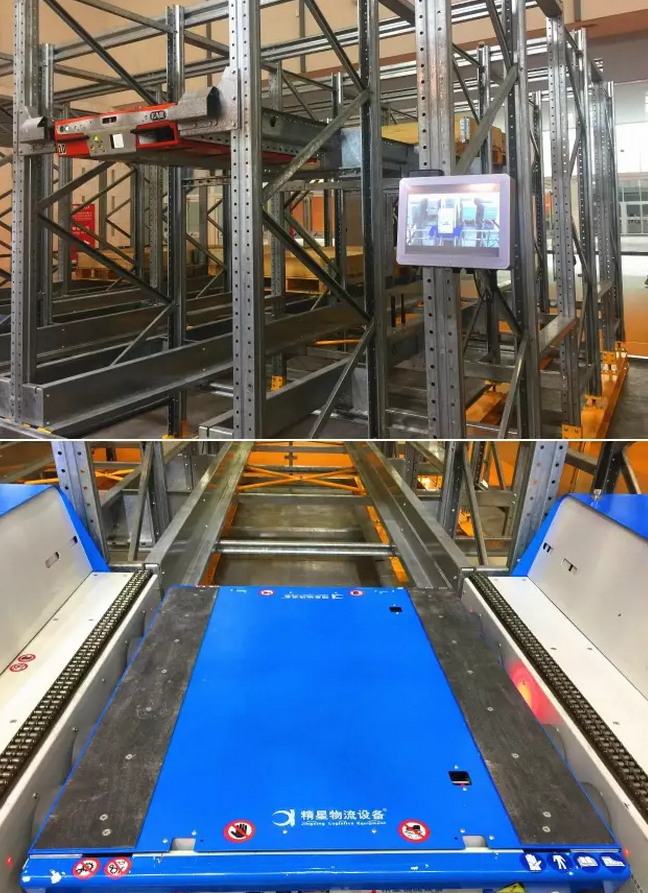
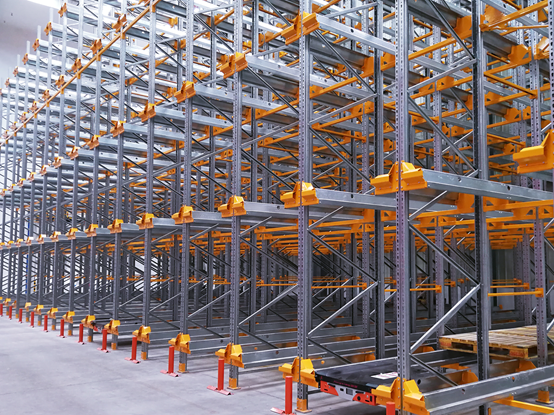
Semi-automated RF-controlled carrier that runs on rails inside drive-in racking — eliminating forklift damage and increasing storage density by 25–30%. The lowest-cost entry to pallet storage automation.
A radio shuttle is a battery-powered carrier vehicle that travels on rails installed inside a deep pallet storage lane. The forklift operator places the carrier into the lane using a handheld RF remote or tablet app — the carrier then automatically drives to the optimal storage position and deposits or retrieves the pallet without a forklift entering the racking structure.
This eliminates the leading cause of racking damage in conventional drive-in systems: forklift collisions with racking uprights. It also removes the need for forklift clearance between pallet stacks, allowing pallets to be stored 100mm apart — increasing positions by 25–30% versus standard drive-in racking in the same lane.
FIFO (First-In First-Out) layouts are available using a double-entry tunnel configuration. Cold-rated carriers with heated battery compartments operate in -25°C environments.
The operator uses a forklift to lift the radio shuttle carrier and place it onto the rails at the entrance of the target storage lane.
The operator issues a store or retrieve command via handheld RF remote or optional tablet app. The carrier acknowledges and begins autonomous operation.
The carrier drives to the first available position (store) or retrieves the outermost pallet (retrieve), using onboard sensors for lane-end detection and pallet presence confirmation.
On retrieval, the carrier brings the pallet to the lane entrance. The forklift operator picks it up from there — never entering the racking lane.
Forklift never enters the racking bay. The most common cause of racking damage and associated inspection downtime is eliminated at source.
No forklift clearance between pallet faces — carrier brings pallets close together. Same building footprint stores significantly more pallets.
The most affordable path to automated pallet storage. Retrofit into existing drive-in racking in many cases — no major civil works required.
Cold-rated carriers with heated battery compartment operate at -18°C to -25°C. Ideal for cold storage facilities wanting automation without a full ASRS investment.
Standard single-entry configuration is LIFO (Last-In First-Out). Double-entry tunnel configuration enables FIFO — appropriate for food, beverage, and pharma products with expiry constraints.
Carrier unit is a standalone device with onboard diagnostics. Battery swap for multi-shift operations in minutes. No complex WCS software or IT integration required.
| Pallet size | Standard EUR / ISO / block pallets; custom rail pitch available |
| Max pallet load | 1,500 kg |
| Carrier speed (loaded) | 0.6–1.0 m/s |
| Carrier speed (unladen) | 1.2–1.5 m/s |
| Lane depth | 5–30+ pallets deep |
| Storage mode | LIFO (single entry) / FIFO (double entry) |
| Control | RF handheld remote + optional tablet app (iOS/Android) |
| Battery type | Li-ion (standard) or lead-acid; heated option for cold chain |
| Battery runtime | 8–10 hr per charge (ambient); reduced in cold |
| Charge time | 2–3 hr full charge |
| Racking height compatibility | Up to 12m |
| Temperature range | -25°C to +40°C (cold-rated carrier required below 0°C) |
| Lane-end detection | Ultrasonic sensors + mechanical stop |
| Pallet presence detection | Onboard optical sensor |
Tell us your lane depth, pallet count, and building temperature. We'll respond with a budgetary quote within 24 hours.