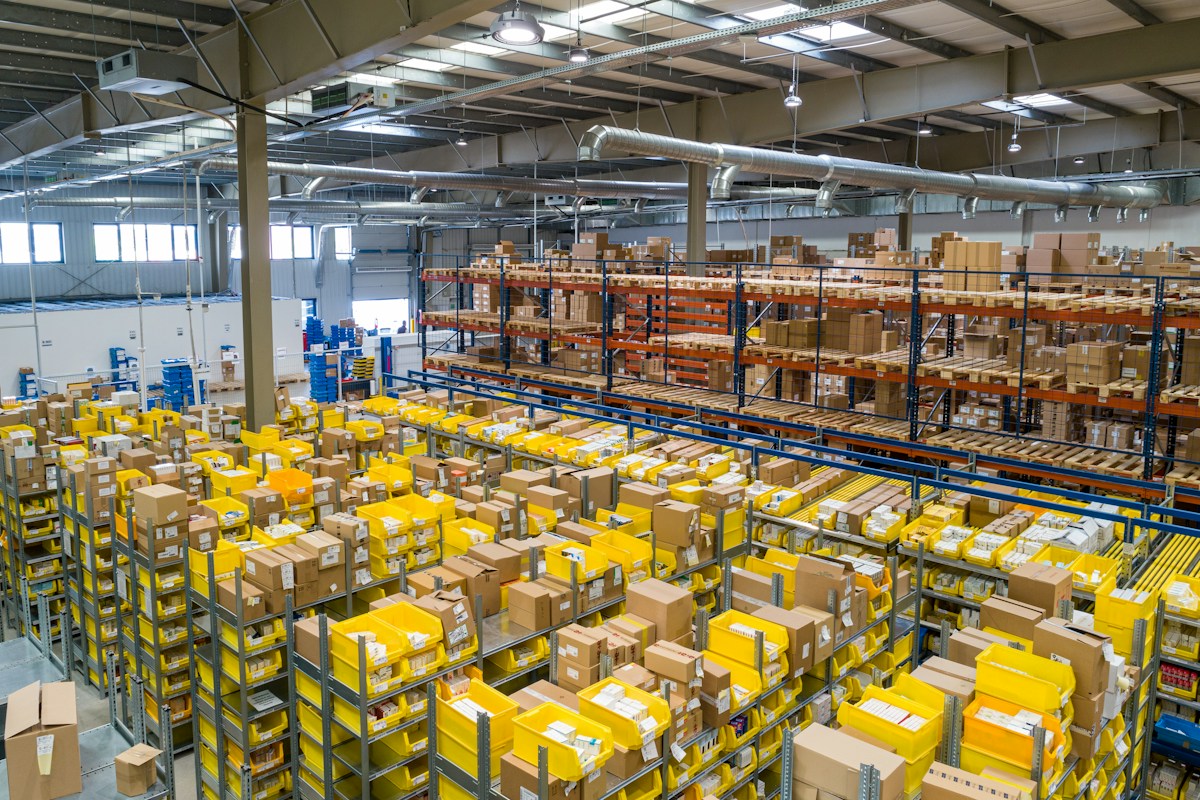
The 4-way pallet shuttle is the fastest-growing technology in automated warehouse storage. Global deployments have scaled from niche pharmaceutical and cold chain applications to mass-market retail, e-commerce, and FMCG distribution — driven by rising labour costs, land scarcity, and the need for 24/7 throughput.
What Is a 4-Way Pallet Shuttle?
A 4-way pallet shuttle is a battery-powered robotic vehicle that travels autonomously within a racking structure to store and retrieve pallets in any direction — forward/backward on the X-axis and left/right on the Y-axis within the rack. Unlike a traditional forklift or stacker crane, the shuttle operates entirely inside the racking, eliminating aisle width requirements and dramatically increasing storage density.
The shuttle sits on dedicated rails built into the rack structure. An external stacker crane or reach truck places the shuttle into the rack level, and from there it operates independently, moving pallets to/from pick positions at the rack face.
How a 4-Way Shuttle System Works
A complete shuttle AS/RS system consists of several subsystems working in concert:
- Shuttle vehicles — battery-powered autonomous carts, typically one or more per rack level
- Racking structure — purpose-built steel rack with integrated rails and guide profiles
- Lifts / elevators — transfer shuttles and pallets between rack levels
- Conveyors / transfer cars — move pallets to and from pick/pack stations at ground level
- Warehouse Control System (WCS) — orchestrates all movements, optimises task sequencing, interfaces with WMS
- Drive components — VFDs, servo drives, motors, sensors controlling all motorised elements
Typical cycle time for a shuttle retrieval task — including lift movement, shuttle traversal, and conveyor delivery — ranges from 90 to 180 seconds depending on rack depth and height. Multiple shuttles operating in parallel on different levels dramatically increase throughput, enabling systems to achieve 200–600+ pallet moves per hour.
4-Way Shuttle vs. Stacker Crane: Which Should You Choose?
| Criterion | 4-Way Pallet Shuttle | Stacker Crane (ASRS) |
|---|---|---|
| Storage density | ⭐⭐⭐⭐⭐ Very high (no aisles) | ⭐⭐⭐ Good (one aisle per crane) |
| Throughput scalability | Add shuttles per level — linear scaling | Limited by crane speed; add cranes = more aisles |
| Redundancy / resilience | High — one shuttle failure = minimal impact | Low — crane failure = aisle offline |
| SKU mix / FIFO | Full random access, FIFO | Full random access, FIFO |
| Height | Up to 40m+ with lifts | Up to 45m+ in single structure |
| Cold chain | Excellent — compact heat generation | Good — crane-based systems proven |
| Investment (relative) | Higher initial (more components) | Lower for single-aisle simple setups |
| Best for | High throughput, dense storage, cold chain | Very tall structures, simple pallet flows |
The general rule of thumb: if you need more than 100 pallet moves per hour per aisle, or if your storage density requirement rules out aisles, 4-way shuttles win. For simpler single-temperature, lower-throughput operations, stacker cranes can offer a lower total cost.
Cold Chain Applications: The Shuttle Advantage
Cold chain — frozen and chilled storage at temperatures from 0°C to −25°C — is one of the fastest-growing segments for 4-way shuttle systems, and for good reason:
- Labour elimination: No forklifts or operators inside the cold zone reduces energy loss from door opening cycles and eliminates cold-related health risks for workers
- Space efficiency: Land for cold rooms is expensive. Eliminating aisles can increase pallet capacity by 60–80% in the same footprint
- Energy savings: High-density storage reduces the refrigerated air volume per pallet stored
- Drive component selection: All VFDs, motors, sensors and wiring must be rated for the operating temperature. Control Techniques Unidrive M700 and ABB ACS880 are commonly specified with cold-rated options
Projects like the ISG Australia cold chain installation (covered in our case studies) demonstrate that shuttle AS/RS systems can deliver reliable 24/7 operation in deep-freeze environments when correctly specified.
Key Drive Components in a Shuttle System
The drive package is often underestimated in shuttle system procurement. Poor drive specification is a leading cause of commissioning delays and in-service failures. Here's what each subsystem requires:
Shuttle Vehicle Drives
The shuttle's onboard motors (travel and fork/lift mechanisms) are typically powered by integrated servo drives or compact VFDs. Requirements include:
- Dynamic torque response for rapid acceleration/deceleration
- Regenerative braking capability (energy fed back to battery)
- Functional safety (STO — Safe Torque Off) for emergency stop compliance
- Compact form factor to fit within the shuttle chassis
Lift / Elevator Drives
Lifts carry pallets and shuttles between levels and are typically the highest-power drives in the system (15–75 kW). Control Techniques Unidrive M700 is one of the most-specified drives for this application globally, valued for its:
- Advanced motion control with encoder feedback
- Safe Torque Off (STO) and Safe Stop 1 (SS1) built in
- Regen capability for energy recovery on descent
- Robust performance in −20°C ambient with appropriate derating
Conveyor Drives
Inbound/outbound conveyors typically use standard VFDs (0.75–22 kW range). Siemens G120, ABB ACS580, and Control Techniques Unidrive M200/M400 series are all commonly used. Key requirement: coordinated speed control for smooth pallet transfers.
Sensors & Safety
SICK distance sensors (DT35, DT60 series) are the de-facto standard for shuttle position detection and rack-face monitoring. SICK SafetyEye or light curtains provide operator zone protection at pick stations.
ROI and Payback Benchmarks
ROI varies significantly by application, but global benchmarks for 4-way shuttle systems in established markets typically show:
| Application | Typical ROI Period | Primary Savings Driver |
|---|---|---|
| Frozen food DC (cold chain) | 3–5 years | Labour elimination + energy efficiency |
| FMCG / retail distribution | 4–7 years | Labour + throughput capacity |
| Fashion / apparel | 5–8 years | Space utilisation + error reduction |
| Pharmaceutical / GMP | 5–9 years | Compliance + traceability + labour |
| E-commerce fulfilment | 3–5 years | Throughput speed + order accuracy |
These benchmarks assume labour costs typical of emerging markets (CIS, SEA, Middle East). In higher-wage regions (Australia, Western Europe), payback periods shorten considerably.
Global Project Scale Reference Points
To calibrate project sizing expectations, consider these real-world deployments seen across Asia-Pacific and global markets:
- Pharmaceutical DC, Malaysia: 18,000 pallet positions, 408 shuttle vehicles, 18-metre high-bay
- Apparel DC, Bangkok: 113,000 pallet positions — one of Southeast Asia's largest shuttle installations
- Paper industry, Indonesia: 23,400 pallet positions, 30-metre rack height
- Fashion retail, India: 30,000 positions, 30-metre high-bay, serving 700+ retail stores
- Cold chain, Australia: Freezer-rated shuttle system at 12-metre height for frozen goods logistics
Procurement Guide: What to Ask Your Supplier
When evaluating 4-way pallet shuttle systems, ask suppliers for clarity on these points:
- Shuttle vehicle make and model — who manufactures the shuttle itself? What is the battery chemistry and rated cycle life?
- Drive components specification — which VFDs, servo drives, and motors are used in lifts, conveyors, and shuttles? Are they branded components or OEM?
- WCS interface — does the WCS support your existing WMS (SAP, Oracle, etc.) via standard APIs? Who provides WCS support locally?
- Cold chain rating — if relevant, what is the minimum operating temperature? Are all components rated and tested?
- Spare parts availability — where are spare VFDs, shuttle batteries, and sensor modules stocked? What is the emergency lead time?
- References — can you visit an operational installation in your region or industry?
One critical point procurement teams often miss: the system integrator may not be the component manufacturer. Ensure your service and spare parts contracts cover the actual drive brands installed — not just the system brand. This is where Econocontrol's specialist component supply adds value for global installations.
Summary: Is a 4-Way Shuttle Right for Your Operation?
A 4-way pallet shuttle AS/RS is the right choice when:
- ✅ You need high storage density with no or minimal aisle space
- ✅ Throughput requirements exceed 150+ pallet moves per hour
- ✅ Cold chain or temperature-controlled storage is required
- ✅ Labour costs are rising and 24/7 operation is needed
- ✅ SKU mix requires FIFO or random access (not deep-lane LIFO-only)
It may not be the right choice if throughput requirements are modest (<50 pallets/hour), the product range is homogeneous and suited to conventional pallet racking, or if your budget does not support the higher initial investment relative to stacker cranes.
Ready to Specify Your Shuttle System?
Econocontrol supplies 4-way shuttle systems and all associated drive components — VFDs, servo drives, sensors, and motors — for warehouse automation projects across CIS, Middle East, Southeast Asia, and Australia.